When Concentration Is Rational
A large position needs an advantage that is both large and hard to copy.
A concentrated portfolio makes a large claim about what its manager knows.
The manager can be wrong about a company, wrong about the price, or right about both and still have too much money in the position. A large bet needs enough advantage to pay for all that uncertainty.
That raises a useful question: where would an advantage that large actually come from?
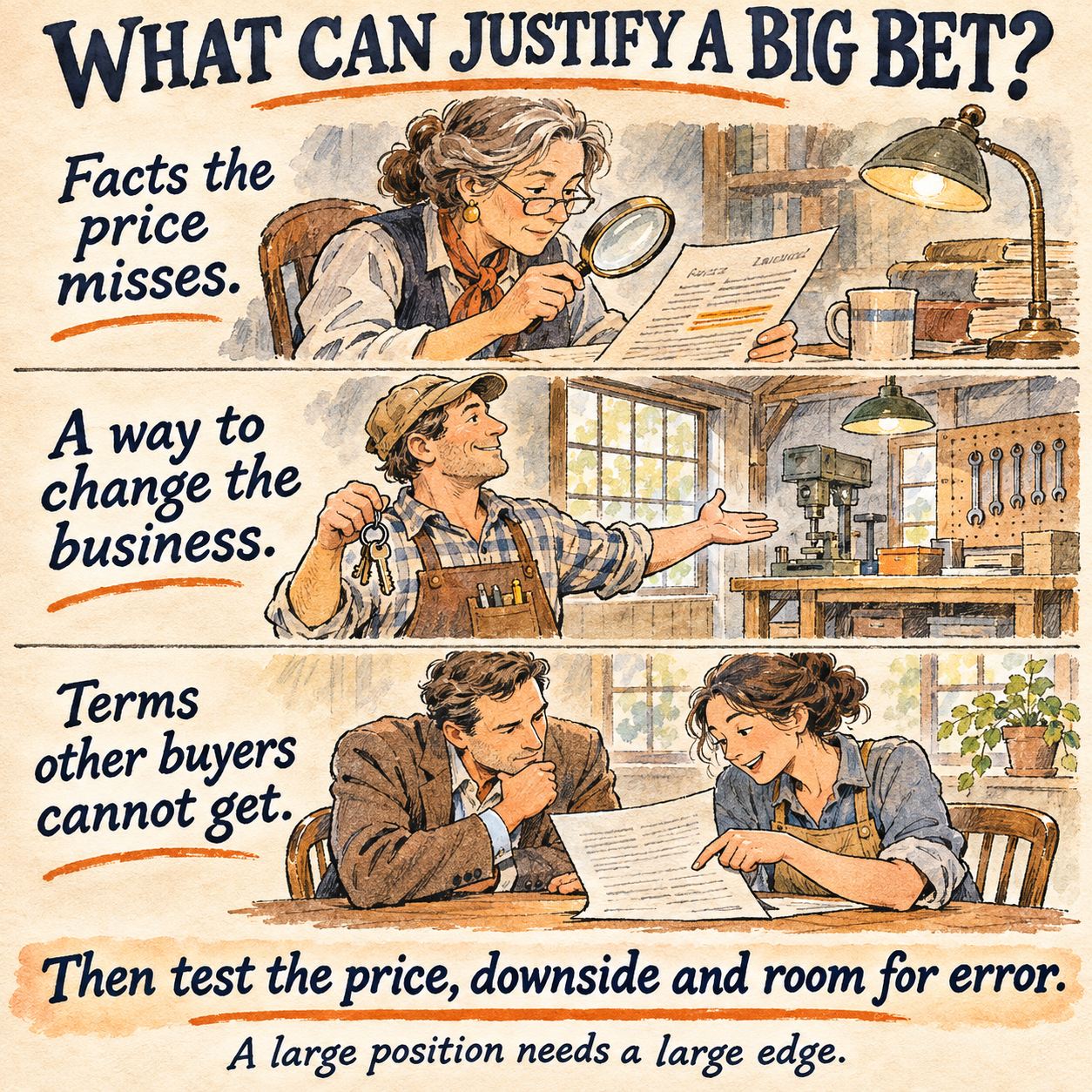
There are situations where an investor knows something unusually useful, can change the outcome, or can buy on terms that other investors cannot get. Examine those cases closely. Then compare them with a portfolio of well-known public companies bought after reading the same filings and attending the same earnings calls as everyone else.
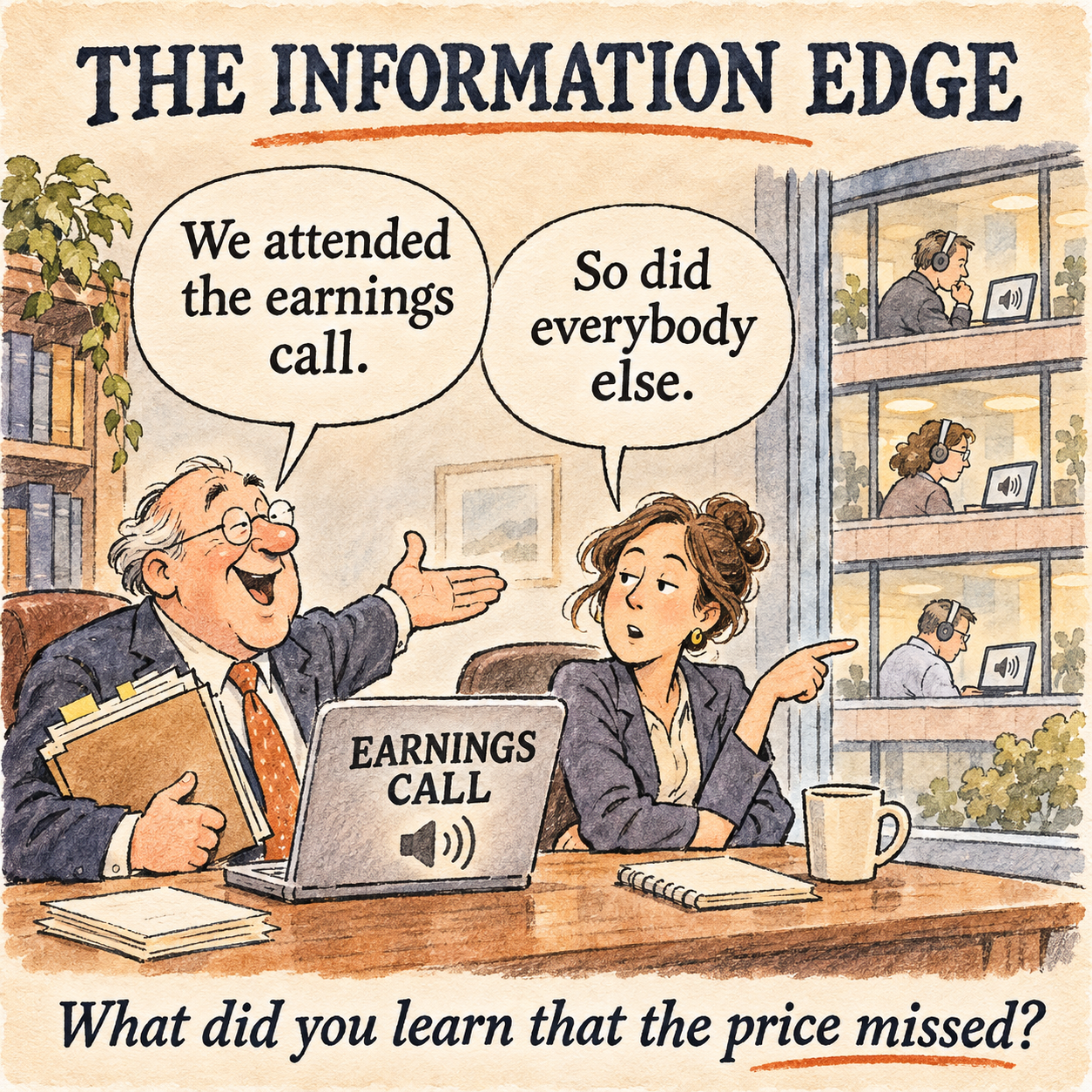
The earnings call had other people on it.
Information has to change the odds
Knowing a business well is valuable. Knowing more than the price already reflects is the investment problem.
An analyst may understand a company's products, admire its management, and correctly forecast years of growth. The stock can still be expensive enough to disappoint. The market may already expect the same growth. It may expect more.
A useful advantage must connect a specific observation to a better estimate of future gains and losses. A large advantage needs a large enough improvement in that estimate to survive mistakes.
Consider an operator evaluating the purchase of a private business. Suppose the buyer can inspect customer contracts, verify costs, and identify work that can move onto an existing operation. The seller and buyer may have different economics. The buyer may also negotiate access to records and protections as part of the transaction.
That is a plausible source of a substantial advantage. It still depends on the facts and the purchase price. But we can explain where it comes from and what would destroy it.
Compare that with an analyst who expects slightly faster growth at a large listed company. That forecast may be useful. It needs evidence before it deserves a position built around the assumption that the analyst knows far more than the market.
Buffett's Amex bet was a specific opportunity
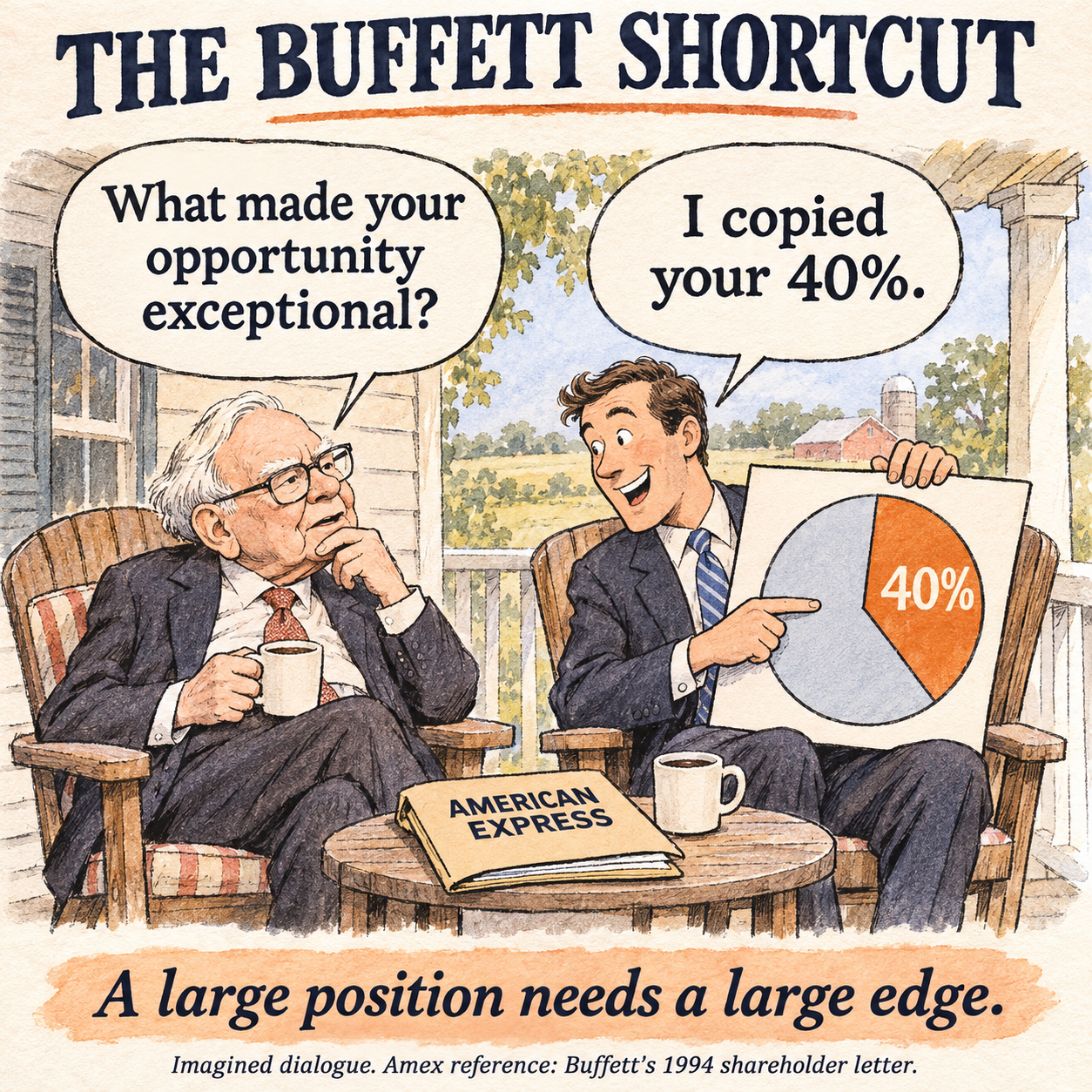
Buffett's American Express investment is often reduced to a percentage. In his 1994 shareholder letter, he recalled putting about 40% of partnership capital into the stock in the mid-1960s, after the salad-oil scandal. It was the partnership's largest investment. Berkshire's 1994 shareholder letter.
That history gives us an investment to study. What was the business worth after allowing for the scandal's losses? How much of that value remained in its customer relationships and continuing operations? What did the purchase price assume, and what could make the assessment wrong?
A manager invoking Amex should explain the corresponding opportunity in today's holding. The percentage alone tells us neither the advantage Buffett had nor the right size for someone else's investment. The outcome cannot supply the probabilities that were uncertain when the money went in.
A checkable gap and a way to close it
Buffett's Sanborn Map investment offers a concrete historical case. His letter covering 1960 described a position representing 35% of partnership net assets. He reported that, in 1958, the shares traded at $45 while the company's investment portfolio was worth about $65 per share. He also helped bring about a separation that let shareholders exchange stock for portfolio securities. Buffett's partnership letter, January 30, 1961.
That combination matters: assets that could be examined, a substantial price gap, and action to release value. The existence of assets alone did not put cash in shareholders' pockets. Governance and execution mattered too.
A manager invoking this example should be able to identify the corresponding facts in today's position. What can be verified? What is the gap after liabilities and costs? Who can close it? What happens if they cannot?
“We think the market will eventually appreciate this business” answers a much easier question.
Negotiating a different investment
Sometimes the advantage sits in the contract.
Berkshire's 2008 letter described fixed-income investments in Wrigley, Goldman Sachs, and General Electric that combined high current yields with equity participation. These were financing packages with terms different from an ordinary common share. They still carried risk. Berkshire's 2008 shareholder letter, printed page 16.
A buyer of common stock cannot assume those terms apply to the shares on the screen. A preferred claim, an option to buy shares, or a negotiated protection can change the range of outcomes. A target price in a research report cannot do that.
The same distinction applies to control. A buyer able to change management, sell assets, or restructure a business has tools that a passive minority shareholder may lack.
These are identifiable advantages. They are also poor excuses for putting a huge weight in an ordinary share when none of those tools is available.
A seller who has to sell
A large opportunity can also arise because the other side cannot wait.
Coval and Stafford studied mutual-fund transactions associated with investor flows over 1980–2003. They found price pressure around constrained selling and returns to investors providing liquidity. That documents a mechanism through which public shares can become mispriced. Asset Fire Sales and Purchases in Equity Markets.
The diagnosis still matters. A falling share price does not identify a forced seller. Bad news can also make a business worth less.
To claim this advantage, an investor needs evidence about the selling, a reason to trust the business value, and enough spare capital to survive further selling. Buying something that fell is easy. Establishing that the seller's constraint created a bargain is the work.
These opportunities also arrive when conditions permit. A mandate to own ten large positions every month cannot make a forced seller appear on schedule.
The small opportunity that cannot become a large position
Specialist knowledge can matter in an obscure company or a difficult corporate event. Low attention can leave something useful for a prepared investor to find.
But an opportunity can be large relative to the money available and tiny relative to a fund.
Take a hypothetical $1 billion fund. Suppose only $2 million of shares can be bought at an attractive price before the opportunity disappears. Buying all of them creates a 0.2% position. A 10% position would require $100 million.
Calling it the manager's best idea does not produce the other $98 million of cheap shares.
The point is broader than small companies. The advantage must survive the amount of money being put to work. A bargain available to a small buyer may be unavailable to a large one. A concentrated fund needs evidence that the opportunity supports its dollars, as well as its enthusiasm.
What remains in widely followed public equities
Public-company filings are available through EDGAR without a subscription. Access to those documents alone cannot establish that a manager has information other investors lack. SEC filing search.
There is still work to do. Investors can interpret facts differently, ask better questions, notice a neglected detail, or forecast more accurately. Common information does not force everyone to reach the same answer.
But a forecast built from widely available information starts with a harder burden of proof. Why should capable competitors be missing something large? Why does the advantage remain after they trade? Why does it survive mistakes about demand, margins, competition, financing, and the price investors will pay?
My starting view is that the usual manager buying widely followed common stocks lacks the conditions behind an unusually large edge. There is no special contract, no control over the business, no demonstrated forced seller, and no clearly established information gap. There may be real skill. The case for a very large bet remains unmade.
Research does find stock-selection skill, including evidence that managers' strongest ideas do better than their other holdings. The question remains how large the advantage is relative to the possible losses and the risks already in the portfolio. The evidence notes below discuss that research.
Patience helps only after the edge exists
A patient source of capital can help an investor hold through an unfavorable price move. A need to meet withdrawals or repay borrowing can force an exit first.
Those constraints affect how much risk the investor can bear. They do not improve the underlying investment merely by giving it more time. A weak thesis can remain weak for years.
Even Buffett's stated concentration policy was conditional. His January 1966 partnership letter reserved weights as high as 40% for rare opportunities with unusually strong grounds for confidence in the facts and limited prospects for serious permanent loss. The limit was attached to a demanding assessment of the investment. Buffett's partnership letter, January 20, 1966.
The burden of proof rises with the position.
Identify the scarce fact. Explain the constraint or the contractual advantage. Show how much can be invested before the advantage disappears. Work through what happens when the estimate is wrong.
If those answers describe a modest edge, build a portfolio that can make good use of it. A useful advantage does not become larger because the manager has promised to own fewer stocks.
Evidence and calculation notes
What the Buffett examples establish
The Amex weight is a retrospective fact from the 1994 letter. It does not establish an optimal position or measure the information advantage before the investment. The Sanborn example adds specific assets and a corporate action; the asset values alone did not guarantee a recovery.
The early investments used partnership capital. They should not be explained using Berkshire's later insurance float. Buffett's July 1965 partnership letter describes arrangements for partner withdrawals. Capital terms affect the ability to hold an investment, but do not create its expected return.
Evidence of stock selection skill
Antón, Cohen, and Polk's Best Ideas, April 2021 draft finds that managers' strongest ideas outperform and explicitly argues that investors would benefit from greater concentration. That is evidence in favor of concentrating on better ideas. It should be represented fairly. Our further question is how much to put in one idea once possible losses, shared risks, costs, constraints, and uncertainty about the estimated advantage are included.
Capacity example
The $1 billion fund and $2 million of shares available at an attractive price are hypothetical inputs. The available shares represent 2 / 1,000 = 0.2% of the fund. A 10% position needs $100 million, leaving $98 million beyond the assumed cheap supply. The example illustrates the amount that can be invested at a given price; it is not a description of LRT assets or a recommended stock weight.